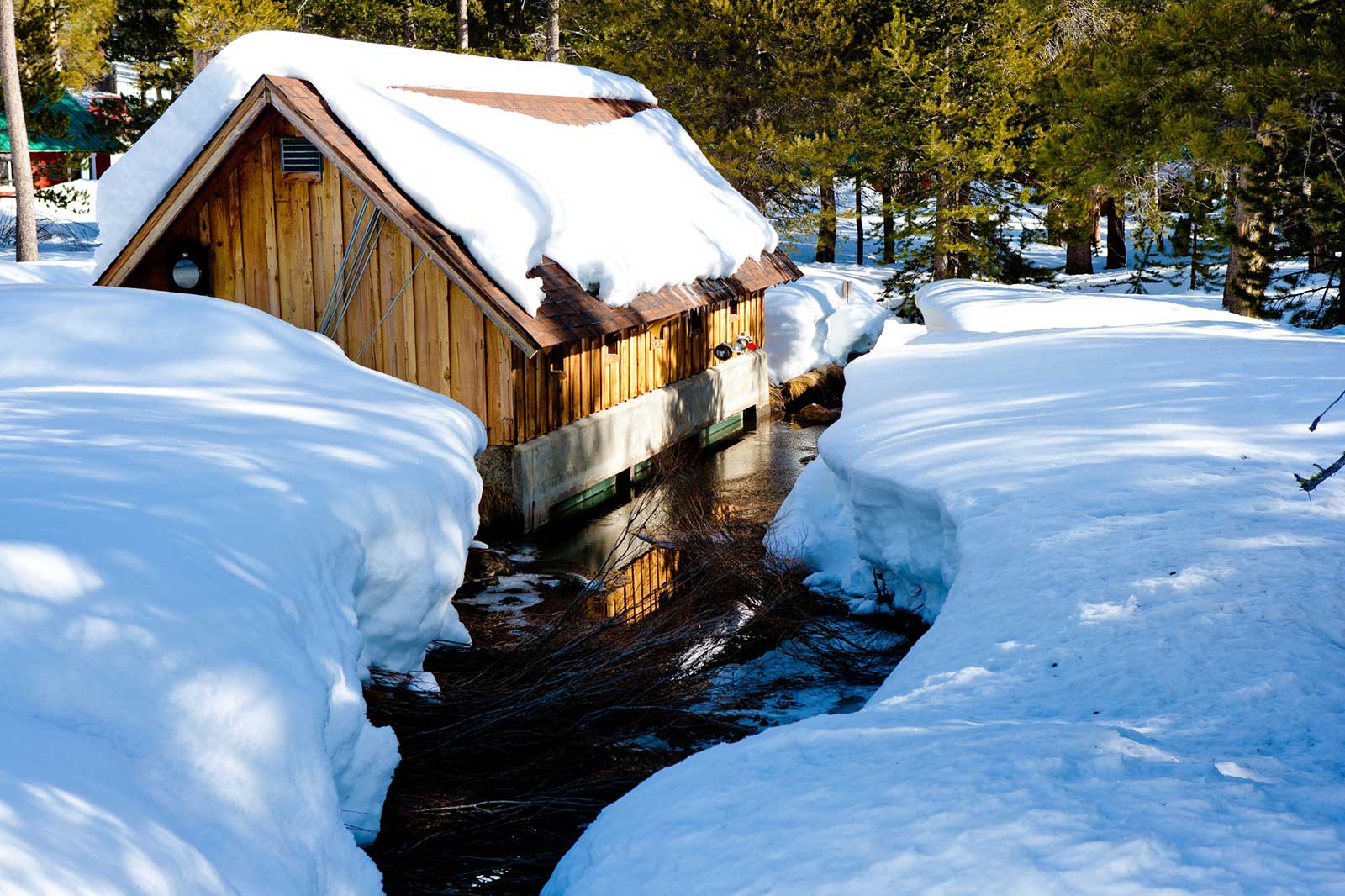
Origins of the Fish Observation Tank
As part of Sagehen Creek Field Station’s original trout research in the 1950s, Professor Needham envisioned observational studies to understand fish behavior. His innovative idea led to the creation of an underwater observatory.
“ Needham wasn’t content just to count and weigh fish. He also wanted to observe their behavior up close. To do this, he needed an underwater observatory, so he sketched his idea on a scrap of paper and gave it to someone else to build.” – (UCNRS Transect, 21:2)
The initial design, a large steel box, faced numerous challenges:
- Unreinforced Windows: Early attempts to install plate-glass windows failed as the curved steel walls caused the glass to break
- Floating Issues: When the structure was placed in Sagehen Creek, it floated despite piling on boulders to weigh it down
Despite these obstacles, students eventually succeeded in making the observatory partially functional. Though it leaked and only submerged 18 inches into the water, Needham and his team used it to observe fish during the harsh Sierra winters.
Evolution of the Fish House
Subsequent iterations of the steel tank improved functionality:
- Rock Ballast Racks: Added to stabilize the structure
- Wooden Tops: Designed for easier access
By the 1980s, these early tanks were no longer in use. Don Erman, Faculty Director (1978–1984), arranged for their removal to a salvage yard. However, the wooden top from the original structure remains on-site near the classroom as of 2018.
“This large steel room and associated rock ballast cages were stored eventually outside the lab buildings when I arrived and I finally arranged as Director for a steel salvage yard in Truckee to haul them away for scrap (at no charge to us) in the 1980s when Mike Yoder-Williams was manager.“
Construction of the Permanent Fish House
In 1962, a grant from the Max C. Fleischmann Foundation funded the construction of a permanent fish observation facility and diversion weir. The facility featured nearly 30 feet of plate-glass windows for underwater observation. This new structure revolutionized fish behavior studies and became a model for other facilities, such as the USDA Forest Service’s Taylor Creek site in South Lake Tahoe.
By the 1970s, the structure faced significant deterioration due to the harsh Sierra Nevada winters. With support from the Golden Gate Angling & Casting Club and additional Fleischmann Foundation funding, the facility was refurbished and modernized.
“The Club members organized raffles, auctions, and other events to raise funds for the restoration, demonstrating their commitment to the station’s legacy.” (Don Erman, 2018) “
A brass plaque at the facility entrance honors the contributions of the Golden Gate Angling & Casting Club and the Fleischmann Foundation.
Significant Discoveries and Contributions
The Fish House has been central to groundbreaking studies and projects:
- Anchor Ice Phenomenon: The discovery and documentation of anchor ice and its effects on aquatic life.
- R. L. Butler and V. M. Hawthorne, Anchor ice, its formation and effects on aquatic life. Science in Agriculture 26(2):2, 1979.
- Brook Trout Reproductive Behavior: Observations leading to detailed films on trout behavior.
- R. L. Butler and V. M. Hawthorne, Reproductive behavior of the brook trout (Salvelinus fontinalis). Film, 1975.
- Restoration Efforts: J. E. Stead’s 2007 Master’s thesis exploring Lahontan Cutthroat Trout reintroduction at Sagehen Creek.